
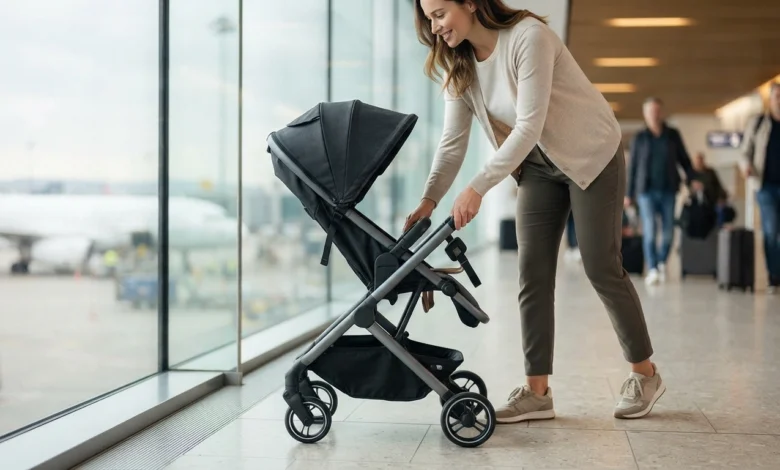
Traveling with a baby can be much easier when parents have the right equipment. A stroller is one of the most useful travel products for families because it provides a comfortable place for a child while making it easier for parents to move through airports, shopping areas, parks, and busy streets. However, choosing the right stroller can be difficult because there are many different designs, sizes, and features available.
For parents who travel regularly, a lightweight stroller can be a particularly practical option. It combines portability with the basic comfort and safety features needed for everyday use.
Table of Contents
What Is a Lightweight Stroller?
A lightweight stroller is designed to be easier to carry, fold, and transport than a traditional full-size stroller. Many models use a compact frame and lighter materials while still providing essential features such as a comfortable seat, safety harness, wheels, and sun protection.
The main advantage is convenience. Parents do not want to struggle with a heavy stroller when moving through an airport, loading a car, or navigating public transportation.
A well-designed Best lightweight Stroller should offer a balance between weight, durability, comfort, maneuverability, and storage.
Why Lightweight Strollers Are Useful for Travel
Family travel often involves situations where portability matters. A stroller may need to be lifted into a vehicle, carried up stairs, or folded before entering a plane or train.
A lightweight model can make these tasks significantly easier.
Some important benefits include:
- Easy to fold and transport
- Convenient for airports and public transportation
- Takes less storage space
- Easier to lift into a car
- Suitable for shopping trips and city walks
- Simple to maneuver through crowded areas
For families who frequently move between different locations, these advantages can make a noticeable difference.
Key Features Parents Should Consider
Not every lightweight stroller is suitable for every family. Before purchasing one, parents should consider how and where they plan to use it.
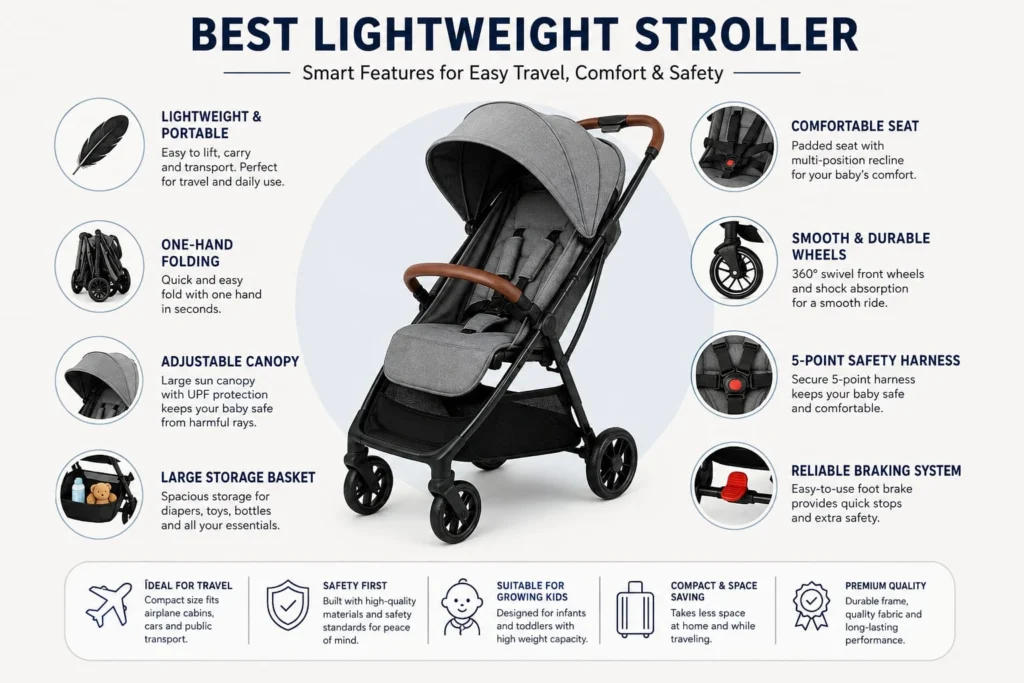
Weight and Folded Size
Weight is one of the first things to check. A stroller that is technically lightweight but difficult to fold may not provide much practical benefit.
The folded dimensions are equally important. Families who travel by car should check whether the stroller fits comfortably inside the available trunk space. Frequent flyers should also check airline policies before traveling.
Safety Harness and Stability
Safety should always come before appearance or convenience. A reliable stroller should have an appropriate safety harness and a stable frame.
Parents should also consider the wheel design and braking system. Good wheels and responsive brakes can make the stroller easier to control on sidewalks and other everyday surfaces.
Comfort for the Child
A stroller is not only about making life easier for parents. The child also needs a comfortable seat.
Features such as adequate padding, a supportive backrest, adjustable reclining positions, and a sun canopy can improve the experience during longer walks.
Storage Space
Parents often need to carry diapers, bottles, snacks, toys, wipes, and other baby travel essentials. A storage basket or additional pockets can therefore be extremely useful.
A compact stroller does not necessarily need to sacrifice useful storage. The best designs make efficient use of the available space.
Strollers for Different Types of Travel
The ideal stroller depends heavily on the family’s lifestyle.
For air travel, parents may prioritize a compact folding mechanism and low weight. For city travel, maneuverability and a small turning radius can be more important. Families who use a car frequently may focus on folded dimensions and trunk storage.
Parents should also think about whether the stroller will mainly be used for short trips or extended outdoor activities. A stroller intended for occasional shopping trips may have different requirements from one used every day.
Choosing a Stroller for Growing Children
Children grow quickly, so parents should check the manufacturer’s recommended age, weight, and height limits before purchasing a stroller. A model that works well for a young baby may not remain suitable as the child becomes larger.
For infants, parents should pay particular attention to reclining capabilities and compatibility with approved infant travel systems where applicable. For older babies and toddlers, seat space, weight capacity, and maneuverability become increasingly important.
Understanding these requirements can prevent parents from purchasing a stroller that becomes unsuitable after only a short period.
The Role of Baby Travel Product Manufacturers
The quality of a stroller depends heavily on its design and manufacturing process. Companies involved in baby travel products may produce different categories, including strollers, car seats, tricycles, and other child mobility products.
Manufacturers that specialize in these products can also provide OEM manufacturing services for businesses that want to develop products under their own brand.
This is particularly relevant for retailers, distributors, and brands looking for customized baby travel solutions. Product development may involve everything from frame design and materials to colors, branding, packaging, and production requirements.
How to Make the Final Decision
Before buying a stroller, create a simple checklist based on your family’s actual needs. Consider:
- How often will the stroller be used?
- Will it be used mainly for travel or everyday activities?
- How much weight can you comfortably carry?
- Does it fold easily?
- Is there enough storage space?
- Does the seat provide sufficient comfort?
- Are the brakes and harness reliable?
- Does it fit your vehicle or travel requirements?
Instead of choosing a stroller based solely on its appearance or the lowest price, compare its practical features with your lifestyle.
Weight Categories: What “Lightweight” Actually Means in Kilograms
“Lightweight” is a marketing term with no legal definition, so compare actual numbers:
- Ultralight: under 5 kg. Minimalist umbrella strollers. Easiest to carry and gate-check, but usually limited recline, small canopies, and lower weight capacity (often 15 kg).
- Lightweight: 5–7 kg. The sweet spot for travel strollers. One-hand fold, decent recline, canopies, and storage, with child weight limits typically 20–22 kg.
- Standard compact: 7–9 kg. More features (larger baskets, better suspension, near-flat recline for newborns) at the cost of portability. Still manageable for car travel, less ideal for flights.
- Above 9 kg is full-size territory — comfortable, but not what travel-focused parents are shopping for.
Check whether the listed weight includes accessories: canopies, bumper bars, and rain covers can add 0.5–1 kg beyond the headline figure.
Umbrella vs. Compact-Fold Strollers Compared
| Feature | Umbrella stroller | Compact-fold (travel) stroller |
|---|---|---|
| Folded shape | Long and narrow | Square, cabin-bag-like |
| Typical weight | 4–6 kg | 6–8 kg |
| Recline | Limited, rarely flat | Often near-flat, newborn-suitable |
| Maneuverability | Basic, small wheels | Better suspension and handling |
| Price range | €80–€180 | €200–€500+ |
| Best for | Short trips, toddlers, tight budgets | Frequent flyers, newborns, daily use |
Safety Standards: EN 1888 and ASTM F833
Two standards dominate stroller safety testing:
- EN 1888 (Europe). Covers stability, braking, harness integrity, pinch points, and chemical safety of materials. Look for the CE mark plus an explicit EN 1888 reference — the mark alone is a manufacturer’s declaration, while named testing adds credibility.
- ASTM F833 (United States). The US equivalent, with similar coverage of structural integrity, restraints, and tip-over resistance.
Practical checks regardless of certification: a 5-point harness (not just a waist strap), brakes that lock both rear wheels, a frame that locks audibly when unfolded, and no accessible scissor-like folding joints where small fingers can be trapped.
Airline Gate-Check Guidance
Most airlines gate-check strollers free of charge: you use it through the terminal and hand it over at the aircraft door, collecting it at arrival. Key points:
- Cabin-approved folds (roughly 55 × 40 × 20 cm or smaller) may be carried into the cabin on some airlines, but policies vary — always confirm with your specific carrier before flying.
- Remove accessories (cup holders, snack trays, parent organizers) before gate-checking; they are the parts most often damaged or lost in the hold.
- Use a padded travel bag for hold transport. Gate-checked strollers are handled as baggage and damage is common without protection.
- Low-cost carriers are stricter: some count larger strollers as checked baggage and charge fees, so verify the policy when booking.
Price Tiers: What You Get at Each Level
- Budget (€80–€150): Basic umbrella strollers. Fine for occasional use and toddlers; expect limited recline and minimal suspension.
- Mid-range (€150–€300): The travel-stroller heartland. One-hand compact fold, good recline, decent canopies and storage. Best value for frequent travelers.
- Premium (€300–€500+): Near-flat newborn recline, superior suspension, premium fabrics, higher weight limits, and cabin-size folds. Worth it for daily use or very frequent flying.
Frequently Asked Questions
Can newborns use a lightweight stroller?
Only models with a near-flat recline (around 170°) or compatibility with an infant car seat / carrycot. Standard umbrella strollers without flat recline are generally suitable from around 6 months, when the baby can sit with support.
What is the maximum child weight for travel strollers?
Most are rated to 20–22 kg (roughly age 4). Ultralight models sometimes cap at 15 kg. Exceeding the limit affects stability and braking — check the manufacturer’s plate on the frame.
Are expensive travel strollers worth it?
For occasional trips, a mid-range model is usually the rational choice. Premium models pay off for daily use or weekly flying, where better suspension, easier folding, and durability compound over hundreds of uses.
How do I clean a travel stroller?
Most seat fabrics are removable and machine-washable at 30°C; check the label. Wipe the frame with a damp cloth, keep folding joints free of sand and grit, and lubricate squeaky wheels with silicone spray (never oil-based products near the child).
One stroller for everything, or a travel stroller plus a daily one?
Frequent travelers often end up with two: a robust daily stroller and a compact travel one. If budget or storage forces one choice, a mid-range compact-fold model with near-flat recline is the most versatile single option.
Final Thoughts
A lightweight stroller can be an excellent choice for parents who value portability and convenience without wanting to give up essential comfort and safety features. Whether the goal is airport travel, city exploration, shopping, or everyday family outings, the right stroller can make transportation considerably simpler.
The most important thing is to choose a model that matches the child’s requirements and the family’s travel habits. By considering weight, folded size, safety, comfort, storage, and durability together, parents can make a more informed decision and find a stroller that works well for their everyday adventures.