
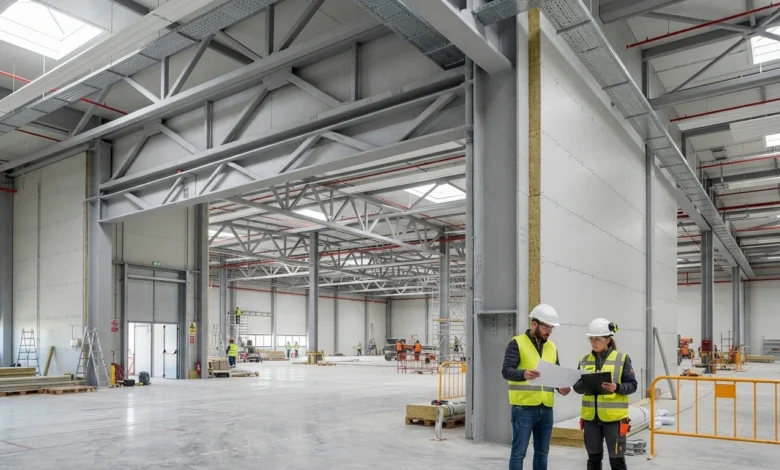
Spain’s industrial construction sector continues to expand as new manufacturing plants, logistics warehouses, cold storage facilities, and distribution centers are developed across the country. Regions such as Valencia, Catalonia, and Madrid are experiencing steady industrial growth, creating a greater need for buildings that meet modern standards for fire safety, acoustic performance, and energy efficiency.
Industrial facilities are expected to comply with both Spain’s Código Técnico de la Edificación (CTE) and relevant European Union (EU) regulations. These requirements influence how buildings are designed, constructed, and maintained throughout their lifecycle. Rather than treating fire protection, sound insulation, and thermal performance as separate considerations, many developers now plan them as integrated systems that improve safety, operational efficiency, and long-term building performance.
This guide explains the role of fireproofing (ignifugación), acoustic insulation, and thermal insulation in Spanish industrial buildings. It also explores the key regulations that shape these systems and highlights why local technical expertise is valuable for projects in regions such as Valencia.
Table of Contents
Understanding Fireproofing in Industrial Buildings
Fireproofing, known in Spain as ignifugación, involves applying protective systems that help structural elements maintain their load-bearing capacity during a fire. Most industrial warehouses (naves industriales) are built with exposed structural steel, which can rapidly lose strength when exposed to extreme temperatures. Without adequate protection, steel structures may become unstable long before emergency services can control the fire.
Passive fire protection systems are designed to slow this process, allowing occupants more time to evacuate while helping preserve the building’s structural integrity.
Common industrial fireproofing solutions include:
- Intumescent coatings that expand when exposed to heat, creating an insulating layer around structural steel.
- Fire-resistant boards and cladding made from materials such as calcium silicate or vermiculite to shield structural components.
- Firestopping systems and sealants used around service penetrations, expansion joints, and openings to prevent flames and smoke from spreading between fire compartments.
These systems are commonly classified according to their fire resistance period, including R30, R60, R90, and R120, which indicate how long structural elements can maintain their load-bearing performance during standardized fire testing. These classifications are based on EN 13501, the European fire classification standard, and are reflected within Spain’s CTE DB-SI (Seguridad en caso de Incendio) requirements.
Fire Safety Regulations for Industrial Buildings in Spain
Compliance with fire safety regulations is an essential part of industrial construction. Spain’s regulatory framework combines national legislation with European standards to ensure industrial facilities provide an appropriate level of protection for occupants, property, and business operations.
The primary regulations affecting industrial fireproofing include:
- Código Técnico de la Edificación (CTE), particularly DB-SI, which establishes fire safety requirements for buildings.
- EN 13501, defining European fire classification methods.
- Local municipal inspection procedures that may introduce additional documentation and compliance requirements depending on the project’s location.
Meeting these standards requires more than selecting certified materials. Proper installation, documentation, and ongoing compliance all contribute to achieving successful project approval and long-term building safety.
Acoustic Insulation for Industrial Facilities
Noise management has become increasingly important as industrial developments expand closer to commercial and residential areas. Manufacturing equipment, ventilation systems, refrigeration units, and logistics operations can generate continuous noise that may exceed acceptable limits if not properly controlled.
Spain’s Ley del Ruido (Noise Law) and local municipal regulations establish noise limits designed to protect surrounding communities while supporting safe working environments within industrial facilities.
Effective acoustic insulation solutions often include:
- Mineral wool and rock wool insulation for sound absorption.
- Acoustic barriers integrated into wall and roof systems.
- High-performance acoustic membranes.
- Vibration isolation systems for machinery and mechanical equipment.
Planning acoustic performance during the design stage helps reduce the likelihood of expensive modifications after construction while improving comfort for employees and neighboring properties.
Thermal Insulation and Energy Efficiency
Thermal insulation plays a significant role in reducing operating costs while maintaining stable indoor temperatures. Facilities involved in food production, pharmaceutical manufacturing, refrigerated storage, and cold chain logistics rely heavily on effective insulation to preserve controlled environments throughout the year.
Spain’s CTE DB-HE, which focuses on energy efficiency, encourages building designs that reduce energy consumption while improving overall environmental performance.
Common thermal insulation solutions include:
- Polyurethane (PUR) insulation panels.
- Polyisocyanurate (PIR) insulation systems.
- Sandwich panels that combine structural strength, thermal insulation, and, in many cases, fire-resistant properties.
Well-designed insulation systems help lower heating and cooling costs, improve indoor climate control, and contribute to more sustainable industrial operations.
Why Fire, Acoustic, and Thermal Protection Should Be Planned Together
Although fireproofing, acoustic insulation, and thermal insulation are often discussed separately, they perform best when considered as part of a single building strategy.
Many construction materials contribute to multiple performance requirements. For example, certain insulation systems improve thermal efficiency while also offering acoustic benefits and supporting fire resistance. Coordinating these systems during the planning phase reduces installation conflicts, minimizes project delays, and can lower overall construction costs.
Integrated planning also simplifies compliance because engineers and contractors can evaluate building performance as a complete system rather than addressing each requirement independently.
Regional Focus: Valencia’s Industrial Growth and Technical Expertise
Valencia has become one of Spain’s important industrial and logistics centers due to its strategic location, expanding infrastructure, and connection to international trade routes. The presence of major transport networks and the Port of Valencia has supported the development of manufacturing facilities, warehouses, and distribution hubs throughout the region.
As industrial construction continues to grow, companies need solutions that meet both technical requirements and local expectations. Industrial projects are not only judged by construction quality but also by their ability to comply with safety regulations, energy standards, and environmental requirements.
Working with specialists who understand the practical application of Spanish regulations can help developers avoid compliance issues and achieve better project outcomes. Local experience can be especially valuable when dealing with inspection processes, material selection, installation methods, and documentation requirements.
Companies such as Acusfoc specialize in industrial fireproofing, acoustic insulation, and thermal insulation solutions for buildings in Valencia and surrounding areas. Their expertise reflects the growing importance of specialized contractors who understand the specific challenges of industrial construction and passive protection systems.
Common Applications of Industrial Insulation Systems
Industrial insulation requirements vary depending on the type of facility, operational needs, and environmental conditions. Different sectors require customized approaches to achieve the right balance between safety, efficiency, and performance.
Manufacturing Plants
Manufacturing facilities often contain heavy machinery, production equipment, and electrical systems that increase the importance of fire protection and noise control. Fire-resistant materials, acoustic solutions, and thermal insulation help create safer and more efficient working environments.
Logistics Warehouses
Modern logistics centers operate with high volumes of goods and continuous movement. Proper insulation helps maintain stable internal conditions while fire protection systems reduce risks associated with large storage areas.
Cold Storage Facilities
Temperature-controlled facilities depend on high-performance thermal insulation to maintain consistent conditions and reduce energy consumption. Insulation quality directly affects operational costs and product preservation.
Distribution Centers
Large distribution facilities require solutions that support safety, energy efficiency, and employee comfort. Combining different insulation systems during construction helps create buildings that perform effectively over the long term.
Key Factors When Choosing an Industrial Insulation Contractor
Selecting the right contractor is an important decision for any industrial construction project. Beyond pricing, companies should evaluate technical knowledge, experience with regulations, and the ability to deliver reliable installation.
Important factors include:
- Experience with industrial buildings and passive protection systems.
- Knowledge of Spanish construction regulations and European standards.
- Ability to provide suitable fireproofing, acoustic, and thermal solutions.
- Quality of materials and installation methods.
- Understanding of regional project requirements.
A qualified contractor helps ensure that insulation systems are correctly designed and installed, reducing future maintenance issues and compliance risks.
Important Considerations for Developers and Facility Managers
Industrial building performance depends on early planning and informed decision-making. Developers and facility managers should consider several factors before beginning construction or renovation projects.
| Consideration | Why It Matters |
|---|---|
| Plan protection systems early | Installing fireproofing and insulation during construction is usually more efficient than making later modifications. |
| Consider all insulation requirements together | Fire, acoustic, and thermal systems often overlap and can be optimized through integrated planning. |
| Select experienced specialists | Regional expertise helps manage inspections, documentation, and installation challenges. |
| Follow Spanish and EU standards | Compliance supports safer buildings and reduces the risk of costly corrections. |
Common Mistakes to Avoid in Industrial Insulation Projects
Even well-planned projects can face problems if insulation requirements are overlooked during design and construction.
Some common mistakes include:
- Choosing materials based only on initial cost rather than long-term performance.
- Installing fire protection systems after construction has already progressed.
- Ignoring acoustic requirements until noise complaints occur.
- Selecting insulation solutions without considering energy efficiency goals.
- Working with contractors without relevant industrial experience.
Addressing these factors early helps create safer buildings while avoiding unnecessary expenses.
Conclusion
Industrial construction in Spain is becoming increasingly focused on safety, efficiency, and regulatory compliance. As manufacturing facilities, warehouses, and logistics centers continue expanding, the demand for reliable fireproofing, acoustic insulation, and thermal insulation solutions will continue to increase.
Successful industrial projects require more than individual products—they need integrated planning, quality installation, and an understanding of both European standards and Spanish construction requirements.
For businesses developing industrial facilities in regions such as Valencia, working with experienced specialists can help ensure that buildings achieve the required levels of fire resistance, energy efficiency, and acoustic performance while supporting long-term operational goals.
FAQs
What is industrial fireproofing in Spain?
Industrial fireproofing, known as ignifugación in Spain, involves applying protective systems to structural elements such as steel frames to improve fire resistance and delay structural failure during a fire.
Why is fireproofing important for industrial warehouses?
Industrial warehouses often use exposed steel structures that can lose strength when exposed to high temperatures. Fireproofing helps protect these structures and supports compliance with fire safety requirements.
What regulations apply to industrial fire protection in Spain?
Industrial fire protection is influenced by Spanish regulations such as the Código Técnico de la Edificación (CTE) and European standards including EN 13501, which define fire classification and safety requirements.
How does acoustic insulation help industrial buildings?
Acoustic insulation reduces noise from machinery, equipment, and industrial operations. It helps facilities meet noise regulations while creating a more comfortable environment for workers and surrounding areas.
Why is thermal insulation important in industrial facilities?
Thermal insulation helps maintain stable temperatures, reduce energy consumption, and improve efficiency in facilities such as warehouses, cold storage buildings, and manufacturing plants.
Why should companies choose local industrial insulation specialists?
Local specialists understand regional construction practices, inspection requirements, and project conditions. This knowledge helps improve installation quality and supports smoother compliance processes.