
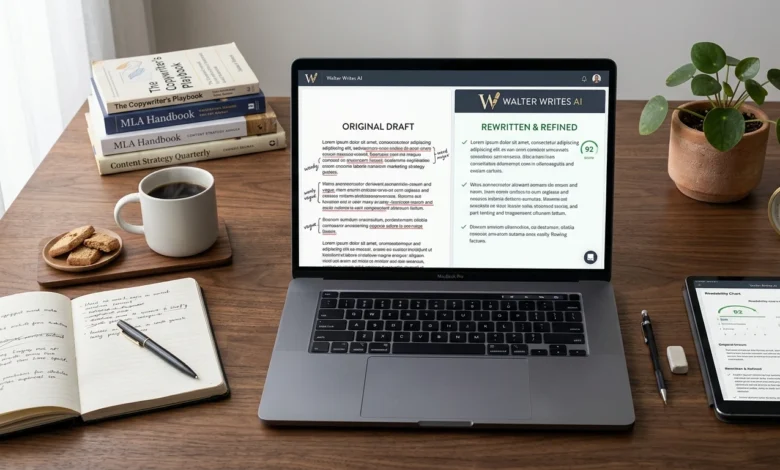
Writers, marketers, students, and businesses often look for tools that can improve existing content without rewriting everything manually. Walter Writes AI is one of the platforms designed for this purpose. Instead of generating articles from scratch, it focuses on rewriting text, improving readability, and refining sentence structure while helping users keep the original message intact. Some users also search for the platform using the spelling WalterWrites AI, but both refer to the same product.
This guide explains what the platform offers, how its writing features work, how to use its humanizer, and what to consider before relying on rewritten content.
Table of Contents
What Is Walter Writes AI?
This is an online writing platform that helps users rewrite and refine existing content. Rather than functioning as a general chatbot, it is designed to improve drafts by reorganizing sentences, changing wording, and making content easier to read.
The platform is commonly used by bloggers updating old articles, marketers revising campaign copy, students improving written assignments, and professionals editing reports or business documents. Since it works with text that already exists, it fits naturally into the editing stage of the writing process instead of the initial drafting stage.
If you search for WalterWrites AI, you’ll reach the same platform. The difference is simply a variation in how users type the product name.
Main Features
Instead of offering a single writing tool, the platform combines several editing functions that help improve existing content.
One of its core capabilities is text rewriting. Users can submit paragraphs, articles, emails, or reports and receive an alternative version with improved wording and sentence flow. This can make long or repetitive passages easier to read without requiring manual rewriting from the beginning.
Another feature focuses on readability. By restructuring sentences and replacing repetitive phrases, the platform can produce content that sounds smoother while preserving the overall purpose of the original document.
It also includes a humanizer feature that rewrites text using more natural language. Rather than simply correcting grammar mistakes, this feature attempts to improve tone, sentence variety, and readability.
Because every document is different, the rewritten version should be treated as an editable draft rather than a finished document ready for publication.
Also Read: Meshy AI What It Is, How to Create 3D Models, and How It Works
How the Humanizer Feature Works
This is designed to transform existing writing into a version that reads more naturally.
The process begins when users paste text into the editor. After processing, the platform analyzes sentence structure, wording, and overall flow before producing a rewritten version. Instead of making only small grammatical corrections, it may reorganize complete sentences, replace repeated expressions, and improve transitions between ideas.
Although the rewritten content often becomes easier to read, it is still important to compare it with the original. Names, dates, statistics, technical terminology, and industry-specific language should always be checked before publishing to ensure accuracy has not been affected.
For most users, the humanizer works best as an editing assistant rather than a replacement for final proofreading.
See Related: Turnitin AI Checker What It Does and How AI Detection Works
How to Use Walter Writes AI
Using the platform is straightforward, even for first-time users.
Start by opening the writing workspace and selecting the rewriting or humanizer tool. Paste the content that needs improvement into the editor and choose any available settings if different rewriting options are provided.
Once processing is complete, read the rewritten version carefully instead of copying it immediately. Compare important details with the original document, correct any wording that doesn’t fit the intended meaning, and make final edits before publishing or sharing the content.
Following this review process helps ensure that readability improves without changing important information or introducing unintended errors.
Where It Can Be Most Useful
The platform supports a wide variety of writing tasks because it focuses on improving existing content rather than generating new material from a blank page.
Bloggers often use it when updating older articles for better readability. Marketing teams can revise product descriptions, advertisements, and promotional copy while keeping the original message consistent. Students may use it to improve the clarity of essays or reports, and professionals can edit proposals, presentations, or business emails before sending them.
Regardless of the document type, the strongest results usually come from combining automated rewriting with careful human editing rather than relying entirely on generated output.
Things to Check Before Publishing
Rewritten content should always be reviewed before it is published or shared. While the platform can improve readability and sentence flow, it may occasionally change wording in ways that affect the original meaning.
Pay special attention to names, dates, statistics, quotations, technical terms, and product information. These details should always match the source material. Reading the entire document from beginning to end also helps identify awkward transitions or repeated phrases that may appear after rewriting.
For business, academic, legal, or technical documents, a final manual review is strongly recommended.
Advantages and Limitations
Like any writing tool, the platform has strengths as well as limitations.
Advantages
- Helps rewrite existing text more quickly.
- Improves sentence flow and readability.
- Reduces repetitive wording.
- Useful for editing blog posts, emails, reports, and marketing copy.
- Simple workflow that doesn’t require advanced writing skills.
Limitations
- Some sentences may still require manual editing.
- Technical terminology should always be reviewed.
- Facts, numbers, and names need to be verified after rewriting.
- The final writing style may still require personal adjustments.
- Output quality depends on the clarity of the original content.
Using the platform as an editing assistant rather than a complete replacement for proofreading generally produces better results.
Walter Writes AI vs Manual Editing
Both approaches serve different purposes, and many writers use them together.
| Walter Writes AI | Manual Editing |
|---|---|
| Speeds up the first editing draft | Gives complete control over wording |
| Suggests alternative sentence structures | Allows precise editing of every sentence |
| Improves readability quickly | Better for maintaining personal writing style |
| Saves time on repetitive revisions | More suitable for highly technical content |
| Still requires review before publishing | Depends entirely on the editor’s experience |
For most writing projects, generating a revised draft first and then performing a careful manual edit provides a good balance between efficiency and accuracy.
Is Walter Writes AI Worth Using?
The platform is best suited for people who regularly revise existing content instead of writing everything from scratch.
Bloggers can refresh older articles, marketers can improve promotional copy, students can enhance readability, and professionals can polish reports or business communications. It can reduce editing time, but it should not replace careful proofreading when accuracy is important.
If your work contains technical language, legal information, research findings, or detailed product specifications, reviewing every rewritten section remains essential before publication.
FAQs
Is WalterWrites AI the same platform?
Yes. it is simply a common spelling variation of Walter Writes AI.
What is Walter AI Humanizer?
It is a feature that rewrites existing text to improve readability, sentence flow, and natural wording while aiming to preserve the original message.
Can it rewrite blog articles?
Yes. It can rewrite blog posts, reports, emails, marketing copy, and other written content that already exists.
Should rewritten text be reviewed manually?
Yes. Always compare the rewritten version with the original to verify facts, names, numbers, and technical terminology before publishing.
Who can benefit from using it?
Content creators, bloggers, marketers, students, educators, and business professionals who regularly edit written material may find it useful.
Conclusion
Walter Writes AI is designed to simplify the editing process by helping users rewrite existing content, improve readability, and create smoother sentence structure. Rather than replacing human editing, it works best as a drafting and revision tool that speeds up the first stage of content refinement.
Its humanizer feature adds another layer of editing by making text sound more natural, but every rewritten document should still be reviewed for accuracy, context, and consistency. Combining automated rewriting with careful manual editing is the most reliable way to produce polished, publication-ready content.