
A commercial invoice is a required legal document that an exporter issues to an importer for international shipments of goods. It’s used by customs authorities to assess duties and taxes, verify the shipment’s contents, and confirm the transaction is legitimate. Unlike a proforma invoice, it’s not an estimate it’s the final, binding record of a completed export sale.
Below you’ll find a real example, a complete field-by-field breakdown, and the difference between a commercial invoice, a proforma invoice, and a packing list.
Table of Contents
Key Takeaways
- A commercial invoice is legally required for nearly all international commercial shipments.
- It’s used by customs to calculate import duties and taxes, and to verify shipment legitimacy.
- Missing or incorrect commercial invoices can cause customs delays, storage fees, or shipment seizure.
- It differs from a proforma invoice (an estimate) and a packing list (a shipment content log).
- Typically 3 copies are needed: one for the exporting country, one for the importing country, and one for the recipient.
What Is a Commercial Invoice?
A commercial invoice is a formal document issued by an exporter to an importer that details the goods being shipped, their value, and the terms of sale. It serves two purposes at once: it’s a bill requesting payment, and it’s the primary customs document used to clear goods across international borders.
It’s used by:
- Exporters and manufacturers shipping goods internationally
- Freight forwarders and customs brokers processing shipments
- Importers who need it to clear goods through their own country’s customs
- Banks verifying trade transactions for letters of credit or foreign exchange
Because it directly affects duty calculation and legal clearance, accuracy on a commercial invoice matters far more than on a typical domestic invoice.
Is a Commercial Invoice Legally Required?
Yes. A commercial invoice is a mandatory document for nearly all international commercial shipments it’s not optional the way a proforma invoice is. Under regulations like U.S. Customs (19 CFR 142.6), the commercial invoice (or an accepted equivalent) must accompany the shipment before customs will authorize its release.
If you ship internationally without a proper commercial invoice, or submit one with incorrect or incomplete information, the consequences can include:
- Customs clearance delays — shipments held until documentation is corrected
- Storage and demurrage fees — costs pile up while goods sit at the port
- Returned or seized shipments — customs can reject or hold goods indefinitely
- Legal penalties — inaccurate declarations can trigger fines in some jurisdictions
- Payment and dispute issues — without it, resolving disagreements over price or quality becomes harder
In short: treat the commercial invoice as a compliance document first, and a billing document second.
When Is a Commercial Invoice Required?
A commercial invoice is needed anytime goods physically cross an international border for commercial purposes. Common scenarios include:
- International shipping and freight — required by carriers like FedEx, UPS, and ocean freight forwarders
- Customs clearance — the core document customs uses to assess your shipment
- Export documentation — needed alongside other paperwork like a Certificate of Origin
- Cross-border B2B sales — whenever goods (not services) are sold to a buyer in another country
It’s generally not required for purely domestic sales or for services that don’t involve shipping physical goods.
Commercial Invoice Example
Here’s what a properly completed commercial invoice looks like for an export shipment:
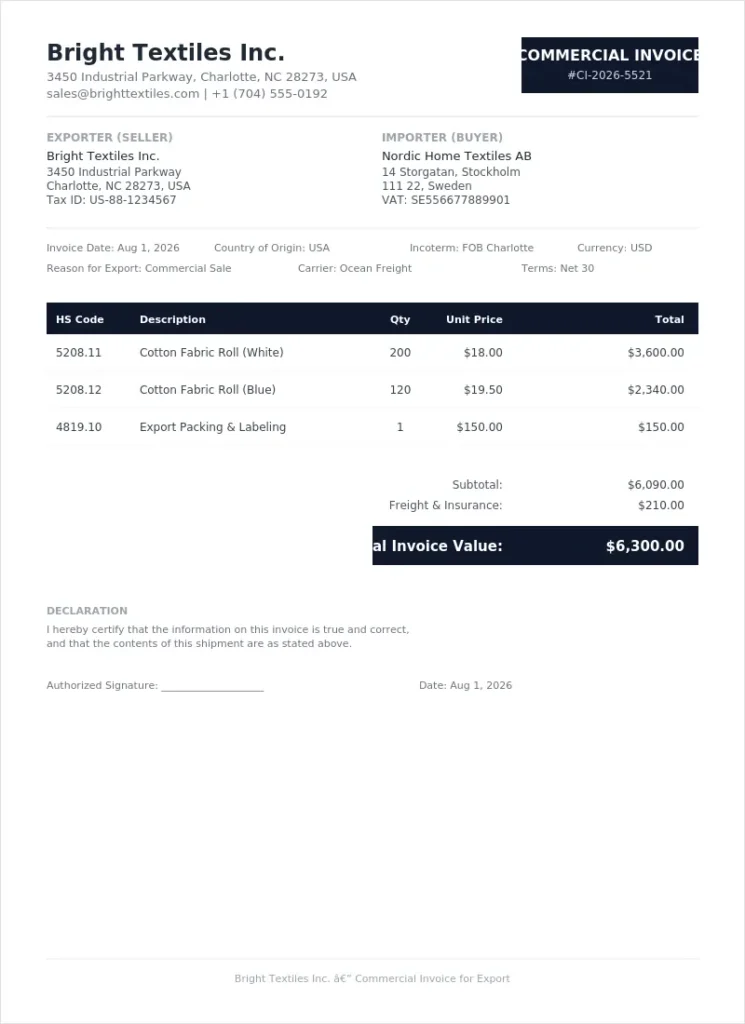
Key fields explained:
- Invoice number — unique reference for tracking this specific shipment
- Exporter/Importer details — full legal business names, addresses, and tax IDs on both sides
- HS Code — the Harmonized System code that classifies each product for customs
- Country of origin — where the goods were manufactured, not shipped from
- Incoterm — defines who’s responsible for shipping costs and risk at each stage (e.g., FOB, CIF)
- Reason for export — customs needs to know if this is a commercial sale, sample, gift, or repair
- Declaration — a signed statement certifying the invoice’s accuracy, often legally required
What Should a Commercial Invoice Include?
| Field | Purpose |
|---|---|
| Invoice Number | Tracks and references the shipment |
| Seller (Exporter) Information | Identifies who’s shipping the goods |
| Buyer (Importer) Information | Identifies who’s receiving and clearing the goods |
| Product Description | Used for customs verification |
| HS Code | Classifies the product for duty assessment |
| Quantity | Number of units being shipped |
| Unit Price & Total Amount | Establishes the shipment’s declared value |
| Currency | Specifies the currency of the transaction |
| Country of Origin | Required for duty and trade-agreement purposes |
| Incoterm | Defines cost and risk responsibility (FOB, CIF, EXW, etc.) |
| Reason for Export | Tells customs whether this is a sale, sample, gift, or repair |
| Payment Terms | Confirms the agreement between buyer and seller |
How Many Copies Do You Need?
Most international shipments require three signed copies of the commercial invoice: one for customs in the exporting country, one for customs in the importing country, and one for the recipient’s own records. Some carriers and countries may require additional copies, so it’s worth checking destination-specific requirements before shipping.
Commercial Invoice vs Proforma Invoice
These two get confused constantly because they look nearly identical but they serve opposite stages of a transaction.
| Commercial Invoice | Proforma Invoice |
|---|---|
| Final, legally binding document | Preliminary, non-binding estimate |
| Issued after the sale is confirmed | Issued before the sale is finalized |
| Used for customs clearance | Not accepted as a customs clearance document on its own |
| Requests actual payment | Gives an estimated cost for planning purposes |
| Recorded for accounting and tax purposes | Not recorded as revenue |
If you’re still deciding between the two for pre-sale quoting, see our full Proforma Invoice guide for a deeper breakdown.
Commercial Invoice vs Packing List
Another common mix-up is between the commercial invoice and the packing list — both travel with a shipment, but they answer different questions.
| Aspect | Commercial Invoice | Packing List |
|---|---|---|
| Purpose | States value, pricing, and payment terms | Describes physical contents and packaging |
| Used by customs for | Calculating duties and taxes | Verifying and inspecting shipment contents |
| Includes pricing? | Yes | No |
| Includes package details (weight, dimensions, carton count)? | Sometimes, briefly | Yes, in full detail |
Carriers typically require both documents together the commercial invoice tells customs what the shipment is worth, and the packing list tells them exactly what’s inside each box.
Also Read: Invoice Example Simple Professional & Business Formats (With Samples)
Common Mistakes When Preparing a Commercial Invoice
Missing Product Details
Vague descriptions (“goods,” “textiles”) slow down customs review. Be specific about material, use, and specifications.
Incorrect HS Code
Using the wrong Harmonized System code can lead to incorrect duty charges or shipment holds — verify codes against the destination country’s tariff schedule.
Wrong Buyer Information
Errors in the importer’s name, address, or tax ID can delay clearance or misroute the shipment entirely.
Currency or Total Errors
Mismatched currency labels or incorrect totals raise red flags with customs and can trigger manual review.
FAQs
What is a commercial invoice?
A commercial invoice is a legal document issued by an exporter to an importer for international shipments, used by customs to assess duties and confirm the transaction.
What is the difference between a commercial invoice and a proforma invoice?
A commercial invoice is final and legally binding, issued after a sale is confirmed. A proforma invoice is a preliminary, non-binding estimate issued before the sale.
Who prepares a commercial invoice?
The exporter (seller) is responsible for preparing the commercial invoice, since they have the shipment and pricing details required.
What information should a commercial invoice include?
At minimum: invoice number, seller and buyer details, product description, HS code, quantity, unit price, total value, currency, country of origin, and payment terms.
Can I create a commercial invoice online?
Yes most carriers (FedEx, UPS, DHL) generate one as part of the shipping label process, and standalone invoice tools can create one manually as well.
Conclusion
A commercial invoice isn’t just paperwork it’s the document that determines whether your shipment clears customs smoothly or gets stuck at the border. Getting the fields right the first time saves you delays, fees, and disputes down the line. If you need to create one quickly and accurately, our Invoice Generator lets you build a professional, export-ready commercial invoice in minutes.